As an Amazon Associate I earn from qualifying purchases. This post contains affiliate links. If you buy through them we may earn a commission at no extra cost to you.
Product prices and availability are accurate as of the date and time indicated and are subject to change. Any price and availability information displayed on Amazon at the time of purchase will apply to the purchase of this product. Certain content that appears on this site comes from Amazon. This content is provided "as is" and is subject to change or removal at any time.
Buying a heart rate monitor is not as easy as it seems at first glance.
The variety of these devices and the wide price range can make the selection process long and painful. The purpose of purchasing a monitor can also be different: from round-the-clock monitoring of the pulse, to recording cardiac activity in the water while swimming.
In this article I will tell you about the types of Heart Rate monitors and what you should pay attention to when choosing one. The recommendations are based on my personal experience, so they will be as practical as possible.
Types of heart rate monitors
According to the method of obtaining information about the pulse, heart rate monitors are usually divided into chest heart rate monitors and optical sensors.
The latter are built into sports watches or fitness bracelets, as well as in the form of separate devices.
Heart rate sensors in watches
Most smart and sports watches are equipped with an optical heart rate monitor located on the back.
This is the most popular type of heart rate monitor, as it is essentially an additional option when buying a watch.
The advantage of such a device is the convenience of wearing and round-the-clock heart rate monitoring.
The need to control the work of the heart can be due to the desire of the user, or medical reasons. For example: the presence of a pacemaker, or underwent heart surgery.
However, it should be noted that this is the least accurate method of measuring the heart rate. This is due to the fact that on the wrist, where the watch is located, there is a wrist joint and a small amount of soft tissues.
Plus, with a loosely fastened strap, the watch can move along the hand, which causes additional errors.
Chest heart rate monitors
The second most popular way to measure heart rate is with a chest strap. It is more reliable and accurate, but less comfortable, since it must be on the chest during the measurement.
The principle of operation is based on recording the electrical activity of the heart. This is the most accurate way to date. Those who have done heart electrocardiography are familiar with it. If you need details, see here.
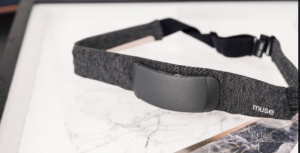
Another feature of the bib is that it records the heart rate and transmits the value to a compatible device.
It can be a sports watch or smart watch, a smartphone, a bicycle computer, an exercise machine in a fitness center, etc.
From the screens of these devices, you can monitor the pulse and control its value.
Optical wrist heart rate monitors
This is the most popular option for measuring heart rate. Although completely undeserved. It works on a similar principle to the optical sensor in a watch, but is designed as a separate device that is attached to the shoulder or forearm.

- HIGH INTENSITY TRACKING: Utilize the integrated optical sensor and built-in accelerometer to precisely track your heart rate in real-time to monitor the intensity of your workout – helping to ensure you are keeping your heart rate in your target zone.
- EXTENDED BATTERY LIFE: Powerful long-lasting rechargeable lithium ion battery with integrated battery cell for extended use. Enjoy up to 24 hours of use time on the full charge to get the most out of your workouts and activities, plus a low battery indicator light to help you track battery life.
- DURABLE and WATERPROOF: The tough, waterproof materials provide long-lasting usage without compromising on performance. Its waterproof rating of IP68 means its perfect for swimming, running outdoors and other intense workouts. It can withstand the elements and keep you going in any environment.
Paid link
In terms of accuracy, he takes an honorable second place after the lapel pin. Due to the fact that it is located in those places where there is a sufficient amount of soft tissues filled with blood vessels, its data are very correct.
Similar to a bib, it transmits data to watches, smartphones and other devices. But in terms of comfort, it overtakes him, since it does not constrain the chest as well as does not fly off during very intense exercises.

What to look for when choosing a heart rate monitor?
Given the variety of options, the choice of a monitor will largely depend on a number of criteria. These include the goals that you set for yourself, the type of sport you plan to do, the intensity of training and the technical features of the devices.
Below we will discuss each criterion in detail and hope to make your choice much easier.
Purpose of using the monitor
From experience we can say that usually a heart rate monitor is bought to solve one of two problems:
- 24/7 heart rate monitoring
- Heart rate monitoring during sports
24/7 heart rate monitoring:
For this, only watches or fitness bracelets with an optical heart rate sensor are suitable. The device will record the pulse constantly – during wakefulness and sleep. As a rule, each watch brand has its own mobile application, where you can see the heart rate chart.
In addition to the pulse, other information will be available, which is either based on data on the work of the heart, or is associated with it. This includes the correct calculation of daily physical activity, assessment of the status of physical activity and recovery, sleep tracking.
When buying a watch for 24/7 heart rate monitoring, we recommend that you pay attention to the accuracy indicators.
The fact that the watch has an optical heart rate monitor does not at all guarantee the accuracy of the data. If heart rate monitoring is necessary for medical reasons, then this parameter becomes critically important.
Heart rate control during sports:
In this case, any kind of heart rate monitor can be used. Taking into account the comfort and accuracy recommendations we described above.
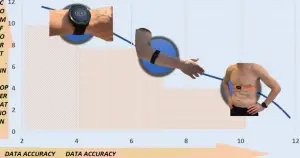
Here is a graph for understanding the ratio of comfort and accuracy of monitors when playing sports.
Each device was roughly rated on a 10-point scale for both parameters. There are no calculations here – this is done for clarity.
Sports related nuances
- In sports where there is heavy hand movement, a watch with an optical sensor may display errors. They can move on the wrist, thus interfering with the receipt of quality data.
- An example is sprint running, where an athlete makes sharp movements with his hands, helping himself to run, or basketball.
- When using an optical sensor in swimming, it is necessary that water does not get between the photocell and the skin, as it refracts light and creates interference. Press down on the sensor as tightly as possible.
- Winter sports such as skiing and biathlon involve outdoor training. The watch, as a rule, is worn over a sleeve of clothing, so the optical sensor will not work. Here only the chest heart rate monitor will save.
- Sports that involve being on the stomach – gymnastics, certain types of strength exercises. A chest strap will not work as it can squeeze painfully on the solar plexus.