
Before you buy a blood pressure monitor, wrap a soft tape around the middle of your bare upper arm and write the number down. That number picks your cuff. The chart the American Heart Association and the AMA use goes like this: 22 to 26 cm (8.7 to 10.2 inches) takes a small adult cuff, 27 to 34 cm (10.6 to 13.4 inches) an adult cuff, 35 to 44 cm (13.8 to 17.3 inches) a large adult cuff, and 45 to 52 cm (17.7 to 20.5 inches) an extra-large one. Then check that the range printed on the box covers your number.
Why bother? Because a cuff that’s too small makes the reading come out high, and one that’s too big makes it come out low. You can buy a well-made, validated monitor and still get the wrong number every single morning if the cuff doesn’t fit your arm.
I’m Shirley. I’m not a pharmacist, a nurse or a doctor, and a home monitor is not a diagnosis. What I do is read the manual, the fine print and the published guidance before the box copy, and then explain it the way I’d explain it to my mom. Anything about what your own numbers mean belongs with your doctor.
What the Wrong Cuff Does to the Reading

Doctors have known for a long time that cuff size matters. What’s newer is a clean measurement of how much. In 2021, researchers at Johns Hopkins ran a trial in Baltimore called Cuff(SZ), published in JAMA Internal Medicine in 2023. They measured 195 adults with a wide range of arm sizes using an automated monitor. Each person got the right cuff, a cuff that was too small and a cuff that was too big, in random order.
Here’s what they found when people were measured with the regular cuff that many clinics use for everyone. If you needed a small cuff, the regular one read your top number (the systolic) 3.6 points lower than it should have. If you needed a large cuff, the regular one read 4.8 points higher. And if you needed an extra-large cuff, the regular one read 19.5 points higher.
That last number stopped me. Nineteen and a half points is the difference between a reading in the normal range and one that gets you a new prescription conversation. The researchers called it “strikingly inaccurate.” The fix wasn’t a better machine. It was a cuff that fit.
How to Measure Your Upper Arm

You’ll want a soft cloth tape, the kind in a sewing kit, and a second person if you can get one. It’s honestly hard to do this well on yourself.
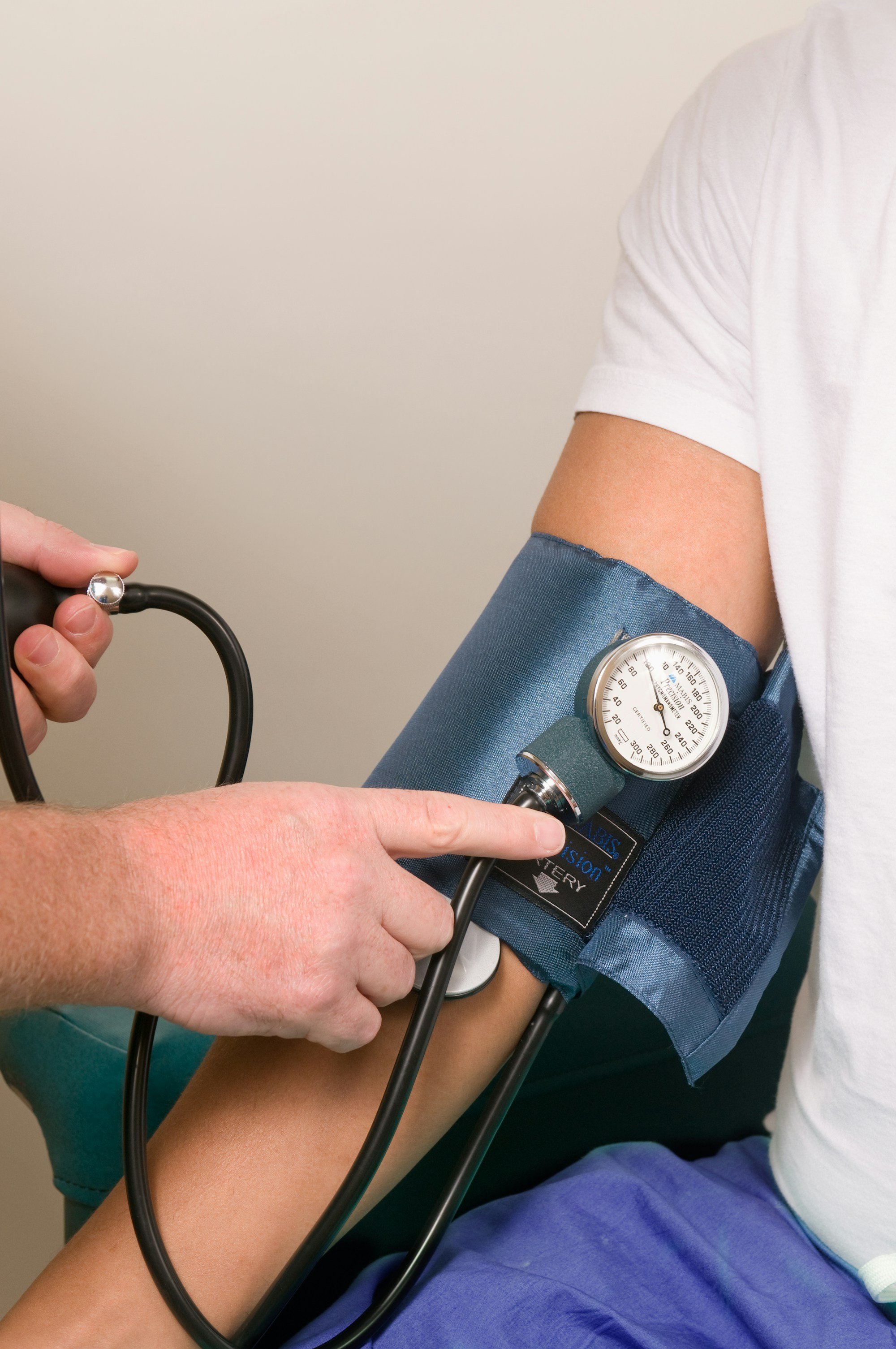
Sit down and let your arm hang relaxed. Roll your sleeve all the way up, or take the shirt off that arm. Find the spot halfway between the point of your shoulder and the point of your elbow. That’s mid-arm, and it’s where the AHA and AMA’s Target: BP guide and Omron’s own instructions both say to measure.
Wrap the tape around your arm at that spot. Keep it level and snug against the skin, without pressing in. Read it in centimeters if your tape has them, since that’s what the chart uses, and jot down the inches too because most boxes print inches. Then do it a second time. If the two numbers don’t agree, measure a third time and use the one that comes up twice.
Measure the arm you’ll actually use. Omron’s instructions say the left upper arm, so if you’re buying one of theirs, start there.
The Four Cuff Sizes, by Arm

Here’s the chart from Target: BP, the program the American Heart Association runs with the American Medical Association. The cuff size is given as the size of the inflatable bladder inside it, width by length, in centimeters. The bladders run 12 by 22 cm for a small adult cuff, 16 by 30 for an adult cuff, 16 by 36 for a large adult cuff and 16 by 42 for an extra-large one.
The rule under the chart is simple. The bladder’s length should be at least 80 percent of your arm’s circumference, and its width at least 37 percent. Target: BP gives a worked example. An arm that measures 40 cm needs a bladder at least 32 cm long, because 0.8 times 40 is 32. That’s usually a large adult cuff.
You’ll notice small gaps in the chart, like between 26 and 27 cm. If you land in one, don’t guess. Read the range on the actual cuff, which brings us to the fine print.
Read the Range on the Box, Not the Word “Large”

Target: BP says it plainly: monitor makers don’t consistently size their cuffs the way the chart does. One brand’s “large” can be another brand’s “wide range.” So the label word means very little. The printed range in inches or centimeters is what counts.
A lot of home monitors now ship with one wide-range cuff. Omron’s Wide-Range D-Ring cuff, for example, fits arms 9 to 17 inches around. That’s about 23 to 43 cm, which covers the top of the small adult range, all of the adult range and nearly all of the large adult range. For most people that one cuff is fine.
Two catches. If your arm is over 17 inches, a 9 to 17 inch cuff isn’t yours, and Target: BP notes that extra-large cuffs are often sold separately. And a replacement cuff only works with the monitors it’s made for. Omron lists the model numbers each cuff fits on its product page, so check yours against that list before you order.
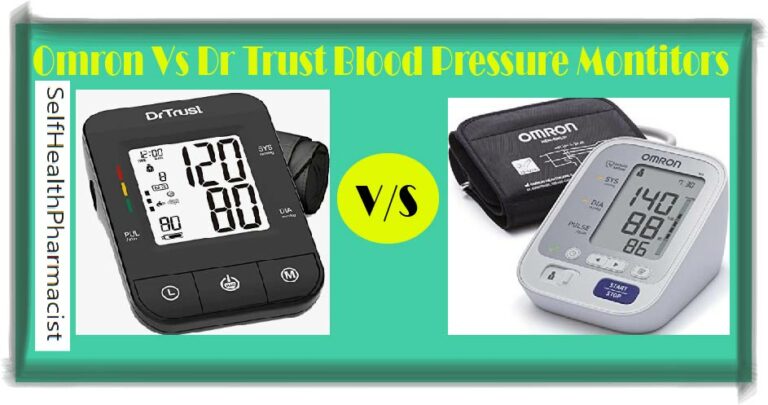
If you’re still comparing brands, I went through two popular ones side by side in Beurer vs Omron Blood Pressure Monitor.
When Your Arm Is Hard to Fit

Some arms don’t play nice with a chart. Very muscular arms, arms that taper a lot from shoulder to elbow, and very large arms can all make a cuff slip or bunch up.
For a very large arm, Target: BP’s guidance is that a wrist cuff is the backup, used only when an upper-arm cuff can’t fit the arm or for a medical reason. Finger devices are a no, and so are cuffless gadgets like smartwatches for managing high blood pressure, at least until better studies come in. I wrote more about that trade-off in Wrist vs Upper Arm Blood Pressure Monitor: Which Reads Truer at Home.
For anything in between, take your tape number and your monitor to your doctor’s office or a pharmacy counter and ask them to look at the fit. It takes five minutes. Getting the cuff right once saves you months of readings you can’t trust.
Even the Right Cuff Has an Error Band

Here’s the part the box never tells you. A good fit removes one big error. It doesn’t make the monitor perfect.
Monitors are validated against a trained person taking the pressure the standard way. Under the ISO 81060-2 test, a device passes when its readings land within 5 points of that reference on average, with the differences spread no more than 8 points around that average. In plain words, any single reading on a validated home monitor can be off by several points. A reading of 128 might really be 123 or 133.
Two habits shrink that problem. First, buy a monitor that’s actually been validated. The AMA keeps a free Validated Device Listing at validatebp.org, and each listed device’s test results were reviewed by an independent committee. Second, look at your average over several days instead of reacting to one number on the display. And bring the monitor to an appointment once so your doctor can compare it with the office’s reading.
When a Number Means Call Someone
I’ll keep this short because it’s not my call to make, and it’s not yours alone either. The guidance cited by the Mayo Clinic and others is this: if a reading is 180/120 or higher, rest for a few minutes and measure again. If it’s still that high, call your doctor. If you have chest pain, shortness of breath, or signs of a stroke like numbness on one side of your face, an arm or a leg, confusion or blurred vision, call 911.
Everything below that line is a conversation for your next appointment, not something to fix with a new cuff or a new monitor. Write your readings down, with the date and time, and bring the list.
The Short Version

Measure your bare upper arm at the midpoint, twice, before you shop. Match that number to the chart, then to the range printed on the cuff, not to the word on the box. A cuff that’s one size too small can push your reading up, and on a big arm it can push it up by nearly 20 points.
Then treat the monitor like any other tool. Pick a validated one, take your readings the same way each time, and let your doctor decide what the numbers mean. If your arm doesn’t fit any cuff you can find, that’s the moment to call someone and ask, not to settle for one that’s close.